
Gruesome Crimes:
Back in 1978, India was not exactly crimefree, but the unimaginably brutal murder of the two teenage kids of an armed forces officer, the subsequent public outrage and the granting of the death penalty to the perpetrators, became such a major crime story, that many films and episodes of TV series have been made about the notorious Billa and Ranga. Prosit Roy’s Raakh has fictionalized it, with names changed and subplots added; what remains is the year—1978—and the modus operandi of the murder.
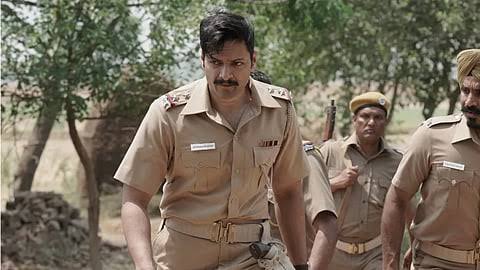
Created, written and co-directed by Anusha Nandakumar and Sandeep Saket, with dialogue by Ayush Trivedi, Raakh has a complicated nonlinear structure, with the build-up to the killing juxtaposed with a police procedural, as an earnest sub-inspector, Jayprakash ‘JP’ Jatav (Ali Fazal) slowly and painstakingly hunts for the killers. Today, there would be CCTV footage and cell phone tracking, but in 1978, the cops had to rely on footwork and rotary phones that were often dead.
The character of JP is about the most interesting thing about the eight-part show on Amazon Prime Video—he belongs to a lower caste, and is studying for an exam, which would get him a promotion. His caste may be why he wants to prove himself, by grabbing a high profile case and won’t let go, even as his superiors want to take it away from him. He lives with his father, Ghanshyam (Rakesh Bedi), a former constable who fills his idle time by cooking and feeding his son and his colleagues, till he comes to be known as “mutton curry wale bauji.” JP is embarrassed by this behaviour, but also loves his father enough to drop work and rush to his side in an emergency. He also has a tentative romance with a Muslim journalist, Nisar (Anshul Chauhan), who uses him as a source, clear in her mind that personal and professional life should be kept apart.
The problematic part of the show is the portrayal of the killers, Babu (Akash Makhija) and his obedient sidekick Rajjo (Ramandeep Yadav). The two of them leave a line of dead or wounded victims in Bombay – including a child they kidnapped for ransom—before escaping to Delhi when the cops get after them.
It is established that Babu was a juvenile delinquent with an extraordinary propensity for violence—be it rape or murder. He believes violence is a sign of manhood and keeps taunting a reluctant Rajjo to be a man. Babu’s cruelty is horrifying, but the show makes him look like a bright-eyed, fearless outlaw.
The crime of shocking savagery occurred when, on a rainy day, Suman (Divya Sharma) and her brother Sahil (Vivaan Sharma), children of army officer Ashok Arora (Aamir Bashir) and his school teacher wife, Mona (Sonali Bendre), accept a lift from Babu and Rajjo. The kids are unable to get out of the car because the handles have been removed from the old style Fiat. Babu drives to a forest area called the Ridge, where the two kids put up a brave fight, leaving the two criminals wounded. Eventually, Babu rapes Suman and kills them both, dumping the bodies in the undergrowth, along with the stolen car.
The till then unknown science of forensics, is introduced to Delhi police by a Dr Baruah (Baharul Islam) and the clues he unearths help JP close in on the two, but they are always a step ahead, either due to an underling’s carelessness, slow communication or Babu’s smart moves. Unfortunately, Babu and Rajjo are seen as shrewd and smooth operators, compared to the flat-footed cops—at one point driving a motorcycle right through a phalanx of cops lying in wait.
Individual scenes leave an impact, like Mona’s denial of her children’s death and her zombie-like insistence on carrying on with her routine, till she is ordered to go home. The father, who actually saw the bodies, is able to grieve.
There is the unique character of Pyare Mohan (Mukund Pal), who sings in a seedy bar in both male and female voices, and becomes a valuable informant.
It is the courage of ordinary people– like the cyclist who sees the kids in the car, and tries to help; and a nurse working with Babu’s girlfriend, who calls the cops when she sees sketches in the newspaper– that holds out hope, at a time when the country was numbed by this crime. A troubled JP tells Nisar that there a time Delhi was so peaceful that wild animals could be seen in the streets, the “Rahu Ketu” pair brought a kind of bestiality to the city that changed its character forever. Interestingly, the two belonged to Mumbai, which was, and is, considered safe. The Emergency is mentioned just in passing, and going into its aftermath was perhaps beyond the remit of the show.
The excessive violence is disturbing—streaming platforms may not be under the purview of censorship, but there is such a thing as restraint, that makers or crime web shows seem to have put aside in favour of sensationalism. Profanity-laden dialogue is de rigueur too.
Ali Fazal brings a wounded ferocity to his role that makes it one of his best performances so far. Rakesh Bedi, Aamir Bashir. Sonali Bendre and the crime show stalwart Dibyendu Bhattacharya bring their strengths to the table. Akash Makhija and Ramandeep Yadav make for truly despicable villains.
So even though the meticulous work that has come into the making of Raakh, can be appreciated, it would be difficult to actually recommend such a morbid show for home viewing.
(This piece first appeared in rediff.com)
